Why Most Habits Fail
Have you ever set a New Year's resolution only to give up a few weeks later?
You're certainly not alone.
Many people fail because they focus on huge lifestyle changes rather than small daily actions.
Common mistakes include:
- Trying to change too many habits at once.
- Setting unrealistic goals.
- Depending on motivation instead of routine.
- Expecting instant results.
- Not tracking progress.
The good news is that these obstacles can be overcome with a better system.
The Science Behind Habit Formation
Habits develop through repetition.
Each time you repeat a behaviour in the same context, your brain strengthens the connection between the cue and the action.
Over time, that behaviour becomes more automatic.
Rather than chasing perfection, focus on repeating small actions consistently.
Habits develop through repetition.
Think of habits like planting a tree, You won't see dramatic growth overnight, but with regular care, the results become impressive over time.
Step 1: Start Ridiculously Small
Instead of saying:
"I'll exercise for an hour every day."
Try:
"I'll walk for ten minutes."
Instead of:
"I'll read fifty books this year."
Start with:
"I'll read five pages tonight."
Small wins build confidence, and confidence builds consistency.
Step 2: Choose One Habit
Trying to improve everything at once usually leads to frustration.
Instead, choose one priority.
For example:
- Exercise
- Better sleep
- Reading
- Saving money
- Drinking more water
- Reducing screen time
- Journalling
- Monitoring your health
- Drinking more water
Once your first habit feels natural, add another.
Step 3: Attach the Habit to an Existing Routine
This technique is often called habit stacking.
Connect your new habit to something you already do every day.
Examples include:
- After making morning coffee, write one journal entry.
- After brushing your teeth, stretch for five minutes.
- After dinner, read ten pages.
- Before bed, complete your sleep journal.
- Linking habits together makes them easier to remember.
- An Exercise Log Book to record workouts and personal bests.
- Sleep Journal to monitor bedtime routines and sleep quality.
- A Debt Tracker to celebrate every payment towards your financial goals.
- A Blood Pressure Log Book to monitor your health consistently.
- A Coffee Journal or Wine Journal to record tasting experiences and build knowledge over time.
- Improvements
- Challenges
- Patterns
- Small victories
- Product design
- Walk daily.
- Stretch each morning.
- Drink more water.
- Monitor blood pressure.
- Sleep consistently.
- Read every day.
- Learn a new skill.
- Listen to educational podcasts.
- Track spending.
- Pay off debt regularly.
- Review your budget weekly.
- Keep a gratitude journal.
- Practise mindfulness.
- Reduce screen time.
- Spend more time outdoors.
- Better sleep
- More workouts completed
- Money saved
- Health improvements
- New skills developed
- 10 Benefits of Keeping a Daily Journal
- Why Tracking Your Sleep Actually Works
- How an Exercise Log Can Keep You Motivated - coming soon
- The Benefits of Monitoring Your Blood Pressure - coming soon
- Why Keeping a Reading Log Helps You Read More - coming soon
- How Tracking Your Spending Can Help You Become Debt Free - coming soon
- Coffee Journals: More Than Just Your Morning Brew - coming soon
- A Beginner's Guide to Wine Tasting Notes - coming soon
- Exercise Log Book
- Sleep Well
- How an Exercise Log Can Keep You Motivated
- The Benefits of Monitoring Your Blood Pressure
- Become Debt Free
- Coffee Journals
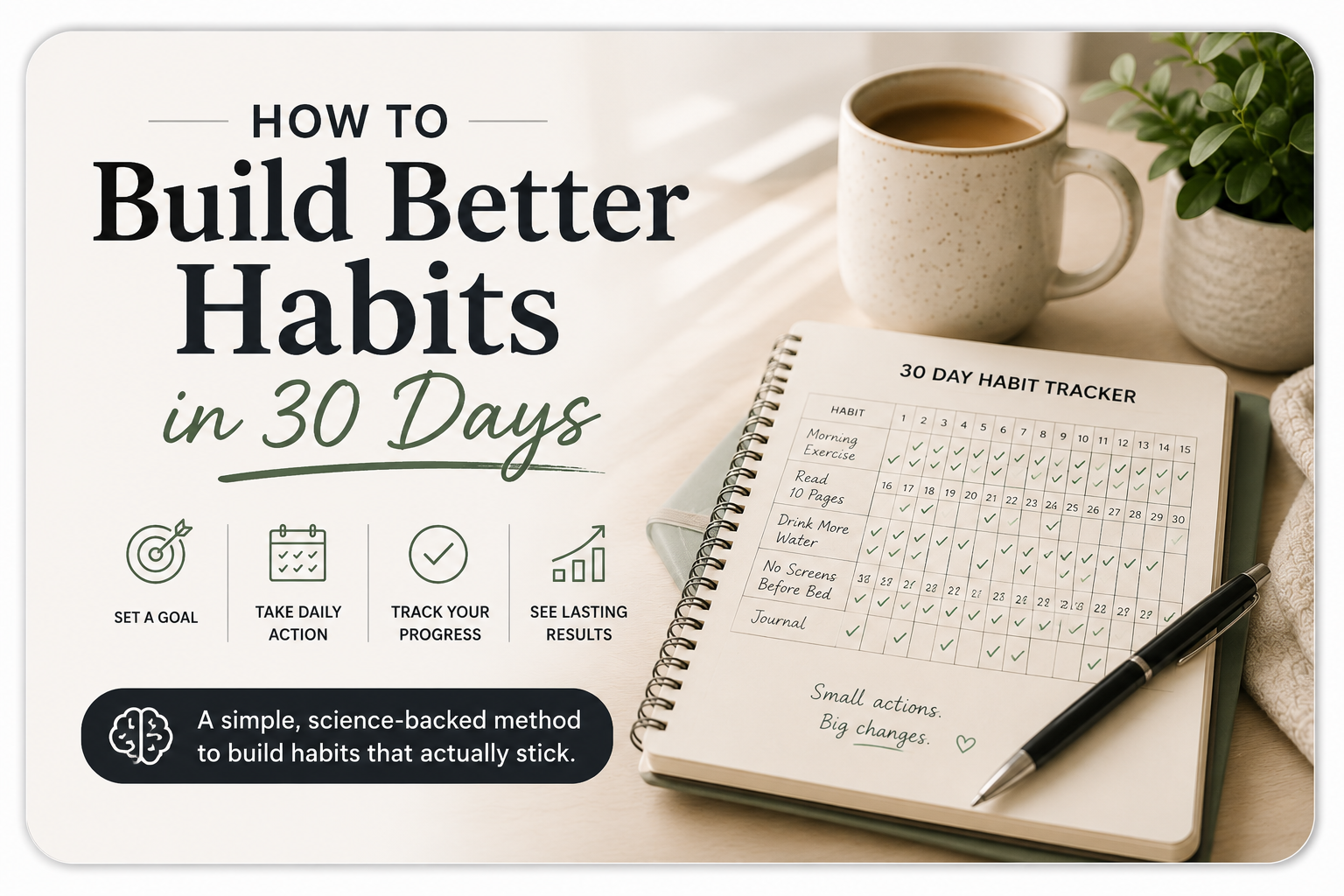
Step 4: Track Your Progress
Tracking is one of the most powerful ways to stay motivated.
Every completed day becomes evidence that you're making progress.
Depending on your goal, you could use:
Watching your progress grow is incredibly motivating.
Step 5: Focus on Consistency, Not Perfection
Nobody follows a habit perfectly.
Missing one day doesn't mean you've failed.
The important thing is returning to your routine as quickly as possible.
A useful rule is:
Never miss twice.
Life happens.
One missed workout or one late night won't undo weeks of progress.
A Simple 30-Day Habit Plan
Week 1 – Build Awareness
Focus on consistency rather than results.
Did I complete today's habit?
What helped me?
What got in the way?
Week 2 – Strengthen the Routine
By now your habit should begin to feel more familiar.
Keep going, even if motivation dips.
Remember:
Routine beats motivation.
Week 3 – Review Your Progress
Look back over your journal.
Notice:
Seeing progress helps maintain momentum.
Week 4 – Make It Part of Your Lifestyle
The final week is about identity.
Instead of thinking:
"I'm trying to exercise."
Think:
"I'm someone who exercises."
Instead of:
"I'm trying to journal."
Think:
"I'm someone who reflects and tracks my progress."
Identity-based habits are often the most sustainable.
Habits Worth Building
Need inspiration?
Here are some habits that can improve everyday life:
Health
Learning
Finance
Wellbeing
Why Journalling Helps Habits Stick
Journalling provides accountability.
Instead of wondering whether you're improving, you'll have written proof.
You'll begin to notice:
Over time, those small daily entries become a powerful reminder of how far you've come.
Common Questions
How long does it take to build a habit?
There's no magic number.
Some habits begin to feel automatic within a few weeks, while others take several months. The key is consistent repetition rather than aiming for a fixed deadline.
What if I miss a day?
Simply continue the following day.
Progress isn't about perfection.
Should I build multiple habits together?
It's usually easier to focus on one habit first before adding another.
Final Thoughts
Better habits aren't built through willpower alone.
They're built through simple actions repeated consistently.
The next 30 days don't need to transform your life overnight.
They simply need to move you one step closer to the person you want to become.
Whether your goal is exercising regularly, improving your sleep, reading more, managing your finances or becoming more organised, the secret is the same:
Start small.
Track your progress.
Stay consistent.
And remember that every small action today is an investment in tomorrow.
Related Articles
Continue building healthier habits with these guides:
Recommended Journals
If you're ready to start building better habits, these journals can help you stay consistent:
Each one is designed to make tracking your progress simple, helping you stay motivated and focused on your goals.